
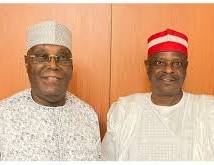
Former Kano State Governor, Rabiu Musa Kwankwaso, on Wednesday hosted former Vice President, Atiku Abubakar, at his residence in Abuja in what observers are already describing as a significant moment in Nigeria’s evolving political landscape ahead of the 2027 general elections.
The former governor of Kano State disclosed that the meeting, which brought together key political figures across different blocs, was an opportunity to strengthen ties within the African Democratic Congress (ADC) and consolidate efforts toward building a formidable opposition platform.
He noted that he personally expressed appreciation to Atiku, the Wazirin Adamawa, for facilitating his reception into the party and reiterated his commitment to ensuring electoral success for the ADC at all levels.
Among those present at the high-level meeting were former Sokoto State Governor, Aminu Waziri Tambuwal, influential political figure Kashim Imam, former Kogi West Senator Dino Melaye, and former Minister Adamu Maina Waziri, alongside other prominent stakeholders.
The gathering is widely interpreted as more than a routine courtesy visit. It reflects intensifying consultations among opposition leaders seeking to reposition the ADC as a credible alternative in a political environment currently dominated by the ruling party and weakened by fragmentation within traditional opposition structures.
Political analysts say the convergence of figures like Kwankwaso and Atiku—both influential in the northern political bloc—signals a potential realignment that could reshape voting patterns, particularly in the North-West and North-East regions where both men command significant grassroots followership. Their collaboration under the ADC umbrella may also attract disenchanted politicians from other parties ahead of what is expected to be a fiercely contested 2027 election cycle.
The ADC, historically considered a fringe party, appears to be gaining renewed traction as a coalition platform. The inclusion of seasoned politicians with executive and legislative experience suggests a deliberate strategy to build a broad-based movement capable of challenging entrenched power structures. Insiders indicate that ongoing consultations are focused on party reforms, grassroots mobilization, and the creation of a unified front to avoid the vote-splitting that has previously weakened opposition chances.
As Nigeria inches closer to 2027, the political atmosphere is gradually shifting from governance to succession calculations. With the likelihood of new alliances, defections, and coalition-building, meetings such as this underscore the early stages of what could become a defining realignment in the country’s democratic journey.
While no formal declarations have been made regarding presidential ambitions or zoning arrangements, the optics of the Abuja meeting point to a growing consensus among key opposition figures on the need for unity, strategic coordination, and a compelling national narrative capable of resonating with voters across regional and ideological divides.
