
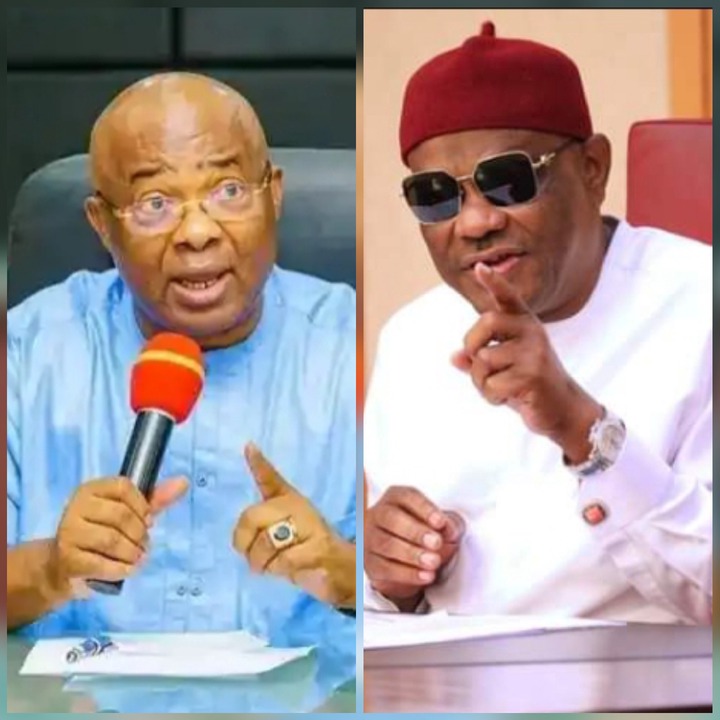
The growing political rivalry between Imo State Governor Hope Uzodimma and the Minister of the Federal Capital Territory, Nyesom Wike, is intensifying as both men jostle for influence over President Bola Tinubu’s re-election strategy in the South-East and South-South regions.
What had long been a quiet disagreement has now evolved into a full-blown political contest, driven by contrasting approaches to mobilising support for Tinubu ahead of the 2027 general elections.
While Uzodimma, who chairs the Progressive Governors’ Forum, insists that the All Progressives Congress (APC) has enough grassroots strength in the regions, Wike has continued to project himself as a key power broker capable of delivering critical votes across several South-South states.
The friction between the two leaders can be traced to the political crisis in Rivers State, where Uzodimma openly backed Governor Siminalayi Fubara during his face-off with lawmakers loyal to Wike. That episode strained relations, and subsequent developments have only deepened the divide, particularly following the state of emergency declared earlier by Tinubu to stabilise the situation.
As the battle for political supremacy unfolds, both camps are now positioning themselves to lead campaign structures in their respective zones. Uzodimma has warned against accommodating politicians he described as opportunistic, urging loyalty to the APC as the only credible pathway to supporting Tinubu’s second-term bid.
He maintained that the party must rely on committed members rather than “crafty politicians” seeking relevance under the guise of support.
Wike, however, appears unfazed, asserting his dominance in Rivers politics and rejecting any external interference. At a recent stakeholders’ meeting, he made it clear that no governor would be allowed to influence electoral outcomes in his state, signaling a direct pushback against perceived incursions by Uzodimma’s allies.
His stance underscores a broader determination to retain control over political structures in the South-South, even as he works across party lines.
Meanwhile, the Minister of Works, David Umahi, has emerged as a central figure in the South-East campaign narrative, drawing praise from a pro-Tinubu group for infrastructure achievements, particularly the reconstruction of the Enugu–Onitsha Expressway. The group, Ndigbo for Tinubu for 2027 Forum, credited Umahi’s performance as a key factor that could sway voter sentiment in the region.
The evolving dynamics have also pulled in other political actors, including former minister Uche Nnaji, whose reported plans to re-enter the Enugu governorship race under a different platform reflect the broader realignments underway. His political moves are seen by observers as an extension of the ongoing contest between Wike’s network and emerging alliances in the South-East.
With both Uzodimma and Wike digging in, the contest for control of Tinubu’s political machinery in the southern regions is shaping up to be a defining factor in the build-up to 2027, raising questions about party cohesion and the balance of power within the ruling coalition.
