
By CHARLES CHIJIOKE
President Bola Ahmed Tinubu has declared that Nigeria attracted nearly $20 billion in foreign direct investments (FDI) this year, crediting the development to reforms designed to improve transparency, efficiency and investor confidence in Africa’s largest economy.
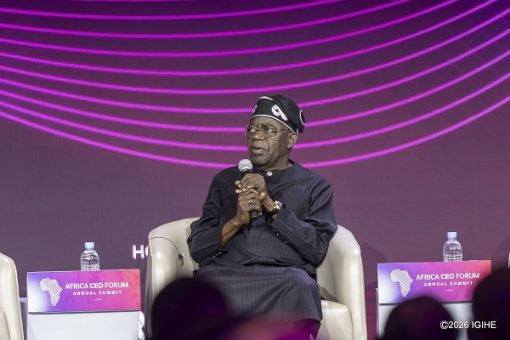
Speaking during a panel session at the ongoing Africa CEO Forum, Tinubu said his administration’s policy direction is repositioning Nigeria as a more competitive investment destination, while urging African leaders to rethink the continent’s economic structure and dependence on external systems.
“In Nigeria, we’ve attracted nearly $20 billion in direct investment this year because we are efficient, transparent, and open for business,” President Tinubu said.
The President linked the claimed investment inflows to economic reforms and efforts aimed at creating a more business-friendly environment, arguing that government policies must work hand in hand with private capital to unlock growth.
He also outlined a broader vision for industrial development, stressing that Nigeria should no longer export raw minerals without domestic processing and value addition.
“With our metals, we can produce batteries for cars. The private sector brings capital and expertise, but government must de-risk and create the enabling environment. That partnership is how Africa moves forward,” he said.
Tinubu used the platform to promote a stronger “Africa First” development model, insisting that African nations must ensure their resources benefit local economies through processing and manufacturing rather than remaining dependent on extraction-focused partnerships.
“We don’t want scavengers and extractors. We want partners who process and manufacture locally,” President Tinubu said.
The President also renewed calls for full implementation of the African Continental Free Trade Area framework, arguing that the agreement must move beyond declarations into practical economic cooperation among member states.
“We have the African Continental Free Trade Area—it must not sit on the shelf. It needs to be activated properly through collaboration and effective use of resources, not by working in silos,” he said.
On energy and industrialization, Tinubu pointed to the Dangote Refinery as evidence that Africa can deliver large-scale projects when governments create favorable conditions.
“Today Nigeria is a net exporter of PMS, aviation fuel, and other products. Dangote is supplying aviation fuel across Africa and to European airlines,” he stated.
The President further questioned Africa’s reliance on foreign currencies in intra-continental trade, suggesting the use of local currencies to reduce transaction pressures and exposure to exchange rate instability.
“If you produce in Nigeria, you can trade in naira. Why should African trade depend on dollars? That adds cost and instability,” President Tinubu said.
He proposed the establishment of an African commodity exchange and also backed the creation of an African credit rating agency, arguing that global rating institutions often fail to accurately interpret African market realities.
“The big American agencies dominate 95 per cent of the market, but they don’t understand our risks and opportunities,” he said.
Tinubu additionally disclosed that Nigeria is laying 19,000 kilometres of fibre optic infrastructure nationwide, which he said will strengthen connectivity and accelerate growth in the digital economy.
“That’s how we bring lessons to children, connect families, and enable traders,” he said, adding: “We need to fund Africa’s shift from basic telecoms to AI and e-commerce.”
The President concluded with a broader appeal for regional cooperation, warning that Africa must act collectively in response to global economic uncertainties.
“Pan-Africanism can’t remain a slogan. It has to be lived,” he said.
The remarks come as Nigeria continues to pursue economic reforms amid inflation concerns, foreign exchange pressures and ongoing debates over the pace and impact of government policies.
While the administration projects confidence over investment inflows and long-term growth prospects, analysts are likely to closely examine the basis and composition of the reported $20 billion figure, particularly whether it reflects actual capital inflows, announced commitments, or projected investments.
If validated, such investment volumes could improve investor sentiment, support infrastructure expansion and strengthen Nigeria’s position within Africa’s evolving economic landscape. However,
implementation, policy consistency and macroeconomic stability are expected to remain critical tests for translating investment announcements into measurable outcomes.
