

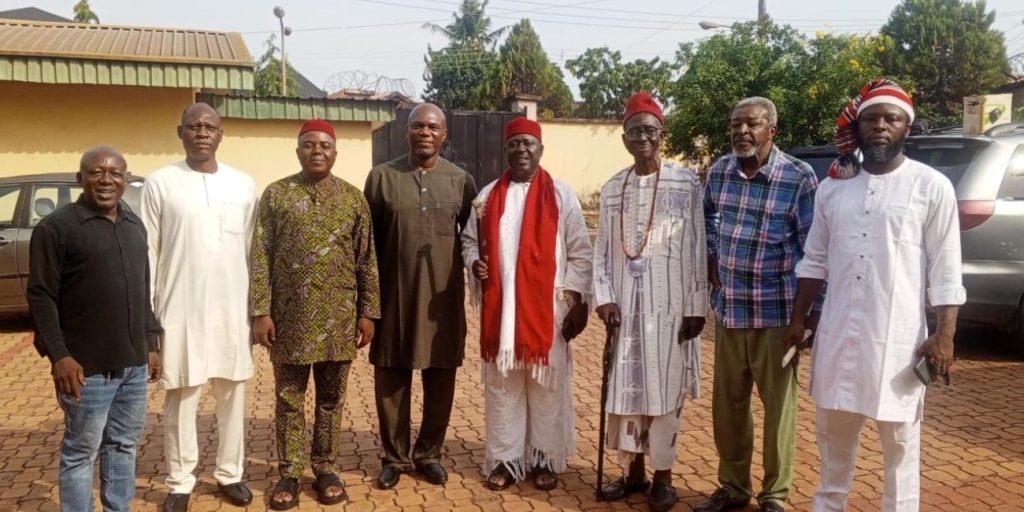
The Igbo Leaders of Thought (ILT), a prominent assembly of Southeastern Nigerian intellectuals, traditional rulers and stakeholders, have again decried the imprisonment of the leader of the Indigenous Peoples of Biafra (IPOB), Mazi Nnamdi Kanu, describing it as painful and unjust despite mounting calls for his release.
The Federal High Court in Abuja, presided over by Justice James Omotosho, had in November 2025 convicted the Biafran leader on terrorism-related charges filed by the Nigerian government and sentenced him to life imprisonment.
Kanu immediately filed an appeal but was swiftly transferred from the custody of the Department of State Services (DSS) in Abuja to a maximum-security correctional facility in Sokoto State.
Speaking Tuesday while receiving a high-powered delegation of Nzuko Ozo Ndigbo Nigeria, President of ILT, Prof. Elochukwu Amucheazi, lamented Kanu’s continued incarceration, insisting it reflects a long history of injustice against the Igbo people.
Amucheazi, who succeeded late Prof. Ben Nwabueze, said Igbos have faced persistent maltreatment from the colonial era to the present day, alleging that global powers and successive Nigerian governments have contributed to their marginalisation.
“General Yakubu Gowon’s three RRRs—Reconciliation, Rehabilitation and Reconstruction—was a mere slogan. The Federal Government said they gave 20 pounds each to Igbos after the war. No one ever gave anything.
“We Igbos have done our best after the war. It is not easy, but I think our people are trying like the Jews tried. The Jews lost six million people, not 60, 600 or 6000, but six million people. And this man (Otto von Bismarck) said a nation is built by blood and iron.
This was what they did in Africa. Where are they today? Where is Portugal today? Where is Spain today? It is la liga all the time. They are playing football all the time. France is gone. Britain is gone too.”
He added that international observers are aware of what he described as the humiliation of the Igbo people.
“Americans and the Jews felt that Igbos were being humiliated and that is why they are doing what they are doing today.
“Look at what is going on in Lagos. All the properties our people legitimately acquired and developed, were destroyed. Governor Sanwo Olu did not express any fear to destroy Peter Obi’s brother’s house in Lagos because Bola Tinubu was beaten in his backyard in the last election.
The worst is that they don’t care.”
On Kanu’s detention, Amucheazi drew comparisons with past political figures.
“Imprisonment of Mazi Nnamdi Kanu is still very painful. Chief Obafemi Awolowo was charged to prison and would have been sent to faraway Borno in Northeastern Nigeria, but Zik refused and sent him to Calabar.
“Awolowo never sat in prison for one day. His wife was treated as a Commissioner/Minister and given a Mercedes Benz car. But look at how Awolowo later hated Ndigbo and even suggested starvation as a fighting tactics against us during the civil war. Starvation claimed the lives of two to three million Igbo children in that war.”
He also criticised post-war policies and national recognition patterns.
“After the civil war, our people went to him about the abandoned properties in Port Harcourt. How did he respond? He thought he would be the next Prime Minister. Well, God has a way of doing His own things.
“Ikeja Airport was named after Murtala Mohammed who committed genocide in Nigeria during the war, not after Awolowo, or Justice Taslim Elias, the first Attorney General of Nigeria. The last road in Victoria Island is Ahmadu Bello way. In Abuja, the two Central roads were named after Ahmadu Bello and Shehu Shagari.”
Amucheazi further questioned ongoing infrastructure projects, alleging deliberate exclusion of the Southeast.
“Those building the coastal road from Lagos to Calabar mooted the idea to bypass the main road to the Eastern part of Nigeria, the home region of the Igbos.
“That is, if they will finish it in 100 years’ time. Somebody told me that they had done five percent of the Lagos-Calabar road at the cost of N7 billion per kilometre, not million. I was told the road is being handled by Chagoury who the FBI interviewed. We are not fools.”
Reflecting on past Igbo intellectual leadership, he praised figures like Prof. Ben Nwabueze and Pius Okigbo for advocating equity, expressing hope that a new generation will continue the struggle.
On the involvement of some Igbo businessmen in the City Boy Movement supporting President Bola Tinubu, Amucheazi suggested coercion played a role.
“That is why they are accepting. You will be surprised that their city boys will vote for Peter Obi on the day of the election. Tinubu has bought a new plane, a yacht and a bulletproof van.”
Earlier, in a digital presentation, National President of Nzuko Ozo Ndigbo Nigeria, Prof. Ike Oluka, called for a revival of the Ozo traditional institution as a pathway to restoring moral order and governance in Igboland.
According to him, “an Ozo title holder is not merely a socialite, but a priest of the Igbo traditional belief system and a custodian of culture,” noting that the institution historically provided leadership rooted in truth, justice and accountability.
“Historically, the Ozo institution served as the bedrock of Igbo leadership for over a millennium before British colonization. These leaders were designed by the people and made for the people, providing a natural governance structure that ensured peace and order, without the need for a standing army or police,” Oluka said.
He stressed that values such as truthfulness, reliability, resourcefulness, defence of the people and respect for human life must be restored to address the region’s socio-political challenges.
Other ILT members present included Secretary Prof. Jerry Chidozie Chukwuokolo and Dr. Joe Nwaorgu.
