
BY CHIJIOKE CHARLES
The Senate has initiated moves to decriminalise attempted suicide in Nigeria, seeking to replace punitive legal provisions with a comprehensive framework centred on prevention, medical intervention and rehabilitation of survivors.
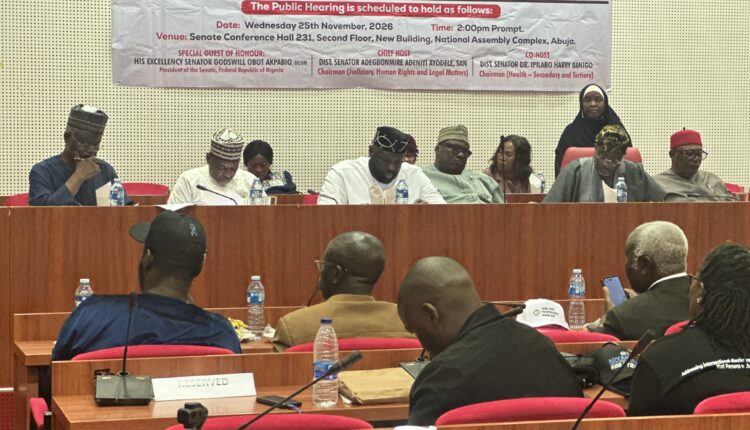
Senate President Godswill Akpabio made this known while declaring open a joint public hearing on a bill seeking to establish a national framework for suicide prevention, decriminalise attempted suicide and provide rehabilitation for survivors.
Speaking at the hearing, Akpabio, who was represented by Deputy Senate Majority Leader, Senator Lola Ashiru, said Nigeria must rethink its approach to people experiencing suicidal crises, stressing that criminal prosecution should not be the first response to a person in need of urgent medical and psychological assistance.
“What is the first response of the state? Should it be prosecution or should it be protection?” he asked.
He observed that existing laws present conflicting positions on attempted suicide, noting that while the Nigerian Mental Health Act recognises it as a psychiatric emergency requiring medical intervention, Section 327 of the Criminal Code and Section 231 of the Penal Code provide for criminal punishment. “This bill seeks to end that contradiction,” Akpabio said.
According to him, proposed legislation would establish a clear responsibility for government to prevent suicide, provide timely interventions for people experiencing mental health crises and support their recovery.
He maintained that Nigeria’s celebrated resilience must also extend to vulnerable citizens facing emotional and psychological difficulties, stressing that individuals going through difficult moments should not be left to confront their challenges alone. “There comes a moment when asking a person to be strong is asking them to do alone what the rest of us ought to help them do,” he said.
Akpabio urged members of the joint committees to examine practical challenges surrounding suicide prevention, including emergency responses to distress calls from families, access to mental healthcare in rural communities and sustained support for survivors following hospital discharge.
He called for contributions from nurses, police officers, social workers, parents, teachers, young people, religious leaders and other stakeholders to ensure that proposed legislation addresses realities confronting Nigerians.
The Senate President further emphasised that effective implementation would depend not only on legislative provisions but also on availability of functional institutions, trained personnel and adequate resources.
He identified families, schools, workplaces and religious institutions as critical partners in creating environments where people experiencing emotional distress can seek assistance without fear of humiliation, discrimination or judgment.
In her remarks,
Chairman of the Senate Committee on Health, Secondary and Tertiary, Senator Ipalibo Harry Banigo, described attempted suicide as both a medical and legal issue requiring coordinated legislative intervention.
Banigo, who was represented by Senator Prof. Francis Adedayo Faduyile, said existing provisions in the National Mental Health Act, Criminal Code and Penal Code had created conflicting approaches to handling survivors of suicide attempts. “We have two proposals on one subject. And it means that this Assembly must legislate once and legislate well,” she said.
She commended Akpabio for supporting legislative reforms and acknowledged the Senate Committee on Judiciary, Human Rights and Legal Matters for collaborating with the health committee to organise the public hearing.
Afrilensnews reports that the proposed legislation, Senate Bill 730, is sponsored by Senator Asuquo Ekpenyong. It seeks to establish a comprehensive national framework for suicide prevention, remove criminal sanctions for attempted suicide and guarantee appropriate medical care, rehabilitation and support for survivors.
Organisations that presented memoranda at the hearing included the Nigeria Police Force, Federal Neuro-Psychiatric Hospital, Enugu, Association of Psychiatrists in Nigeria, Nigerian Psychological Association, Nigerian Bar Association, Nigerian Medical Association, Nigeria Correctional Service, mental health advocacy organisations and Centre for Health, Ethics, Law and Development.
