
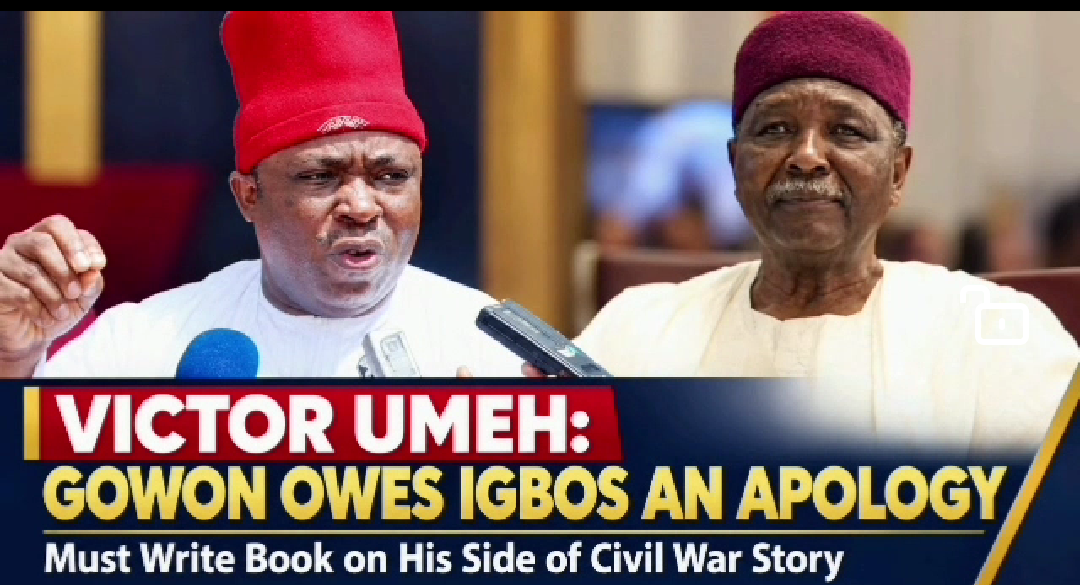
BY CHIJIOKE ASOGWA
Senator Victor Umeh, representing Anambra Central Senatorial District, has accused former Head of State, General Yakubu Gowon (retd.), of distorting the history of the Nigerian Civil War, describing his recent account of the 30-month conflict as riddled with falsehood.
Umeh, who spoke to journalists in Awka, Anambra State, challenged Gowon to document his account of the war in a book, urging him to provide what he considers a truthful explanation of the events that led to the conflict.
Gowon had, in a recent interview on Arise News, blamed the late Biafran leader, Dim Chukwuemeka Odumegwu Ojukwu, for the outbreak of the war and maintained that the conflict was not targeted at the Igbo people.
Reacting, Umeh questioned Gowon’s account, saying the former military leader should use his remaining years to tell the truth about the war and contribute to healing the wounds it left behind.
“We will not allow Gowon to lie or twist history. All that he said are false. At 91, I will not want to join issues with him, except, of course, if he is suffering from dementia. He has not done what he should be doing at this late stage of his life,” Umeh said.
He added that the former Head of State should acknowledge the suffering associated with the war and explain his role in the events that preceded it.
“It is time for him to speak the truth to heal the pains of that war. The war ended 51 years ago and we have moved on, but for him to come back at 91 years of age and begin to lie is unfortunate, and it means that he is not thinking about how to leave Nigeria in peace,” he said.
Umeh also questioned Gowon’s claim that the war was fought to preserve Nigeria’s unity, arguing that the country continues to face serious security challenges.
“He said the reason the civil war was fought was to keep Nigeria one, but is Nigeria one today?” the senator asked.
He challenged Gowon to publish his account of the conflict, adding that a written record would allow future generations to examine his version of events.
“I challenge him again to write his own truthful account of what led to the war. He should know that conscience is an open wound and only the truth can heal it,” Umeh said.
The senator further called on Gowon to apologise to the Igbo people, arguing that the former military leader’s recent comments could deepen the wounds left by the conflict.
“He should stop running around; let him come out boldly and say sorry to the Igbo people of Nigeria,” he said.
Umeh also accused Gowon of laying the foundation for some of the mistrust that has characterised relations among Nigeria’s major ethnic groups. He argued that decisions taken during the period before the war contributed to the political and economic tensions that culminated in the conflict.
According to him, the implementation of the Aburi Accord reached between Gowon’s federal government and Ojukwu was a critical point in the crisis.
“The war ended 51 years ago and we have moved on,” Umeh said, reiterating that the country needed an honest account of the conflict rather than competing narratives that could aggravate old grievances.
The senator maintained that the experiences of the Igbo during the war contradicted Gowon’s assertion that the conflict was not directed at them.
“He keeps claiming the war wasn’t against Igbos, but the facts speak otherwise—Igbo soldiers were targeted, Igbo businesses destroyed, and our people were starved and marginalized,” he said.
Umeh also referred to the role of former Chief of Army Staff, General Theophilus Danjuma (retd.), in the events surrounding the arrest and killing of former Head of State, Major General Johnson Aguiyi-Ironsi, questioning Gowon’s account of his knowledge of developments during that period.
“I cannot sit and watch while people who played central roles in that war continue to distort history. We must tell the truth if we want healing,” Umeh said.
“What happened after Aburi was a complete betrayal, and the attempt now to rewrite history is an insult to the memory of those who died,” Umeh said.
