
BY: CHARLES CHIJIOKE
The Catholic Bishops’ Conference of Nigeria (CBCN) and the Presidency have disagreed sharply over the state of the nation, with security, economic hardship, electoral credibility, religious inclusion and the 2027 general elections emerging at the centre of the controversy.
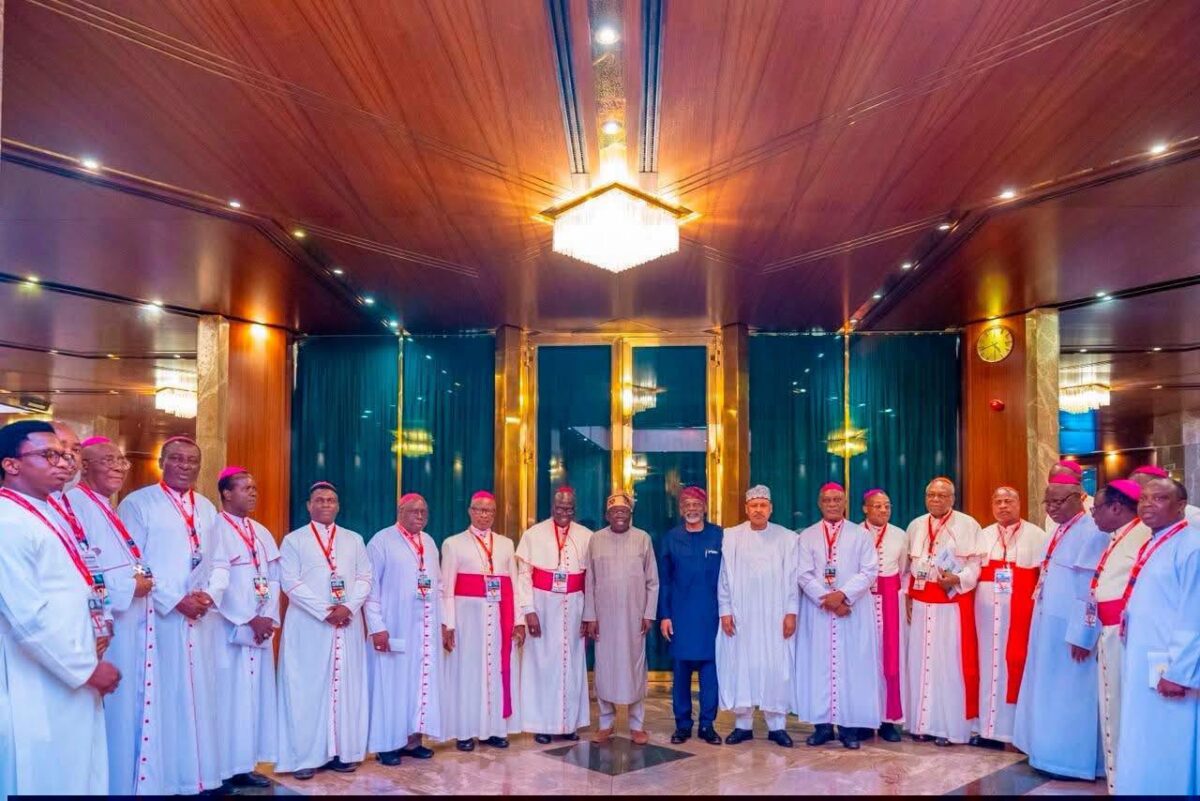
The disagreement followed a July 28, 2026 meeting between President Bola Ahmed Tinubu and a delegation of Catholic bishops led by the President of the CBCN, Most Rev. Matthew Man-Oso Ndagoso, Archbishop of Kaduna. While the Presidency said the government had stabilised the economy and was making progress in the fight against insecurity, the bishops presented a more critical assessment of conditions across the country.
Afrilensnews reports that the Presidency’s account of the meeting said the bishops raised concerns over insecurity, tertiary education, limited university admission spaces, democracy, credible elections, poverty, mission schools and equal access to places of worship. Tinubu, in response, maintained that his administration had placed the country on a sound footing.
“I can tell you categorically with sincerity that the country has been placed on a sound footing. The economy has recovered,” Tinubu said. “This government has stabilised, and there is prosperity on the horizon. Life is improving.”
On insecurity, the President said his administration was strengthening the armed forces and expanding security infrastructure.
“I have just approved the expansion of the armed forces,” Tinubu said. “We are getting more equipment, building new barracks. We will defeat terrorism.”
However, the bishops’ own address, titled “Partners in Building a Just, Peaceful and Prosperous Nigeria,” presented a significantly different picture of the country.
The Catholic leaders acknowledged some government interventions, including the Nigerian Education Loan Fund (NELFund), the rescue of kidnapped schoolchildren and their teachers, and the reception given to Archbishop Paul Gallagher, the Holy See’s Secretary for Relations with States and International Organisations.
But they argued that such measures had yet to translate into sufficient improvement in the daily lives of Nigerians.
The bishops expressed concern over the political implications of the Muslim-Muslim presidency, calling on Tinubu to reassure Christians of their equal place and rights in Nigeria through deliberate government policies and actions.
They also questioned the effectiveness of the student loan programme, arguing that financial assistance alone cannot solve Nigeria’s shortage of university spaces.
The bishops raised further concerns over the federal government’s moratorium on the establishment of new tertiary institutions, warning that restricting expansion could worsen the challenge of accommodating Nigeria’s rapidly growing youth population.
The 2027 elections also featured prominently in their submission. The bishops warned against the emergence of a one-party-dominated political system and urged President Tinubu, who is also the leader of the governing party, to guarantee a level playing field for all political parties.
They linked declining voter participation and growing public distrust to concerns over the electoral process, calling for easier access to Permanent Voter Cards, adequate funding for the Independent National Electoral Commission (INEC), transparent procedures and credible election results.
The bishops warned that anything short of a credible 2027 election could become an “invitation to avoidable disaster.”
Security remained another major point of disagreement. While the Presidency highlighted military operations and successful rescue missions, the bishops said isolated successes could not overshadow continuing attacks on schools, farms, homes, highways and places of worship.
They described Nigeria as “bleeding,” presenting insecurity not merely as a military challenge but as a humanitarian and national crisis.
The disagreement became more public when Cardinal John Onaiyekan, who attended the meeting, appeared on ARISE News on July 31 and disclosed details of the encounter.
“His reply is that the nation is not bleeding,” Onaiyekan said, referring to Tinubu’s response to the bishops. “We told him our economy is not helping our poor people. He told us the economy is doing fine.”
The Cardinal further alleged that individuals around the President were “giving him a rosy picture of what the country is, which it is not.”
“When the nation is bleeding, you can’t expect a polite meeting with the head of state,” Onaiyekan said. “We need to let him know.”
Onaiyekan also attributed the statement “In politics, all is fair” to Tinubu and interpreted it to mean that the administration was determined to win the 2027 election by every available political means.
However, the alleged remark does not appear in the Presidency’s original account of the meeting, meaning the statement remains Onaiyekan’s recollection and has not been independently established through a transcript. The Presidency subsequently pushed back.
On August 1, Senior Special Assistant to the President on Media and Publicity, Temitope Ajayi, published a response on the official State House website titled “Cardinal Onaiyekan’s Abuse of Clerical Privilege.”
Ajayi described Onaiyekan’s decision to publicly recount and interpret a private meeting with the President as “fundamentally inappropriate” and “an abuse of clerical privilege.”
He argued that the bishops requested the meeting, presented their concerns and received the President’s response, suggesting that discretion should have been maintained after the engagement.
Ajayi also rejected the bishops’
assessment of the administration, arguing that their position was “neither scripture nor an article of faith” and could therefore be challenged through facts and evidence.
According to the presidential aide, Tinubu recognises the challenges confronting Nigeria but believes the country has moved out of a “dark tunnel” and established the foundations for economic and security recovery.
The Presidency also rejected suggestions that advisers were shielding Tinubu from the realities facing Nigerians, saying the President receives information through newspapers, television, intelligence reports, operational briefings and contacts across the country.
But Catholic priest Ugochukwu Ugwoke later rejected the Presidency’s confidentiality argument, maintaining that the meeting was neither a sacramental confession nor a legally protected proceeding.
The controversy has therefore shifted beyond the original meeting into a wider debate over who has the more accurate assessment of Nigeria — the government, which points to economic reforms and institutional measures, or the bishops, who focus heavily on citizens’ everyday experiences. Available economic figures offer evidence for both sides.
According to the National Bureau of Statistics, Nigeria’s real Gross Domestic Product grew by 3.89 percent year-on-year in the first quarter of 2026, compared with 3.13 percent during the corresponding period in 2025.
The NBS June 2026 Consumer Price Index report also put headline inflation at 15.91 percent, while food inflation stood at 17.52 percent.
The figures indicate macroeconomic improvement compared with earlier periods, but they do not automatically mean that Nigerians have regained purchasing power or that household living conditions have substantially improved.
This distinction explains why the Presidency can point to economic stabilisation while the bishops continue to speak about hardship, food prices, transportation costs, electricity challenges and declining purchasing power.
The World Bank had similarly acknowledged progress in Nigeria’s macroeconomic stabilisation while warning that the benefits had yet to substantially improve the livelihoods of many Nigerians.
The electoral debate could become even more consequential ahead of 2027. The credibility of INEC will ultimately depend not only on presidential assurances but on the transparency of appointments, adequate funding, reliable electoral procedures, transparent collation and the ability of voters to verify results.
INEC’s review of the 2023 general election recorded 93,469,008 registered voters, while only about 26.7 percent participated in the presidential election.
The low turnout does not by itself establish electoral manipulation, but it highlights a serious challenge for Nigeria’s democracy, particularly if voter apathy and distrust continue into the 2027 election.
The bishops’ warning over one-party dominance could also become politically significant if defections from opposition parties to the ruling party continue. However, defections alone do not prove that Nigeria has become a one-party state.
The more important test will be whether opposition parties can organise, campaign and contest elections without unlawful or institutional disadvantage.
The security question presents another difficult test for the Tinubu administration. Government agencies can point to arrests, military operations, rescued hostages and recovered weapons, but Nigerians will judge progress by whether they can travel, farm, attend school, conduct business and worship without fear.
Ultimately, the clash between the Presidency and the Catholic bishops is not simply a disagreement over statistics or political language. It reflects two different ways of measuring Nigeria’s progress — government performance through reforms, economic indicators and security operations, and citizens’ welfare through food prices, safety, employment, electricity, purchasing power and confidence in democratic institutions.
The consequences of the disagreement could become more significant ahead of 2027. If economic improvements fail to translate into better living conditions, public dissatisfaction could intensify. If insecurity persists, pressure on the government will increase. And if doubts about electoral credibility remain unresolved, the 2027 elections could face heightened public scrutiny and declining confidence.
For President Tinubu, the challenge is therefore to convert macroeconomic gains and security operations into improvements Nigerians can feel in their daily lives.
For the Catholic bishops and other civic voices, the challenge is to ensure that their criticisms are supported by verifiable evidence and translated into constructive engagement.
The final verdict will not come from either the Presidency or the bishops alone. It will come from measurable outcomes — safer communities, stronger purchasing power, improved infrastructure, credible elections and equal protection of citizens’ rights.
Nigeria’s condition, ultimately, will be judged not by competing declarations but by the realities Nigerians experience.
.
