
BY MARTINS EZE
Ahead of the 2026 governorship election in Ekiti State, the Independent National Electoral Commission (INEC) says it has intensified preparations, unveiling a series of measures aimed at addressing security threats, voter participation concerns and electoral malpractice in what may become a critical test of the nation’s election management framework.
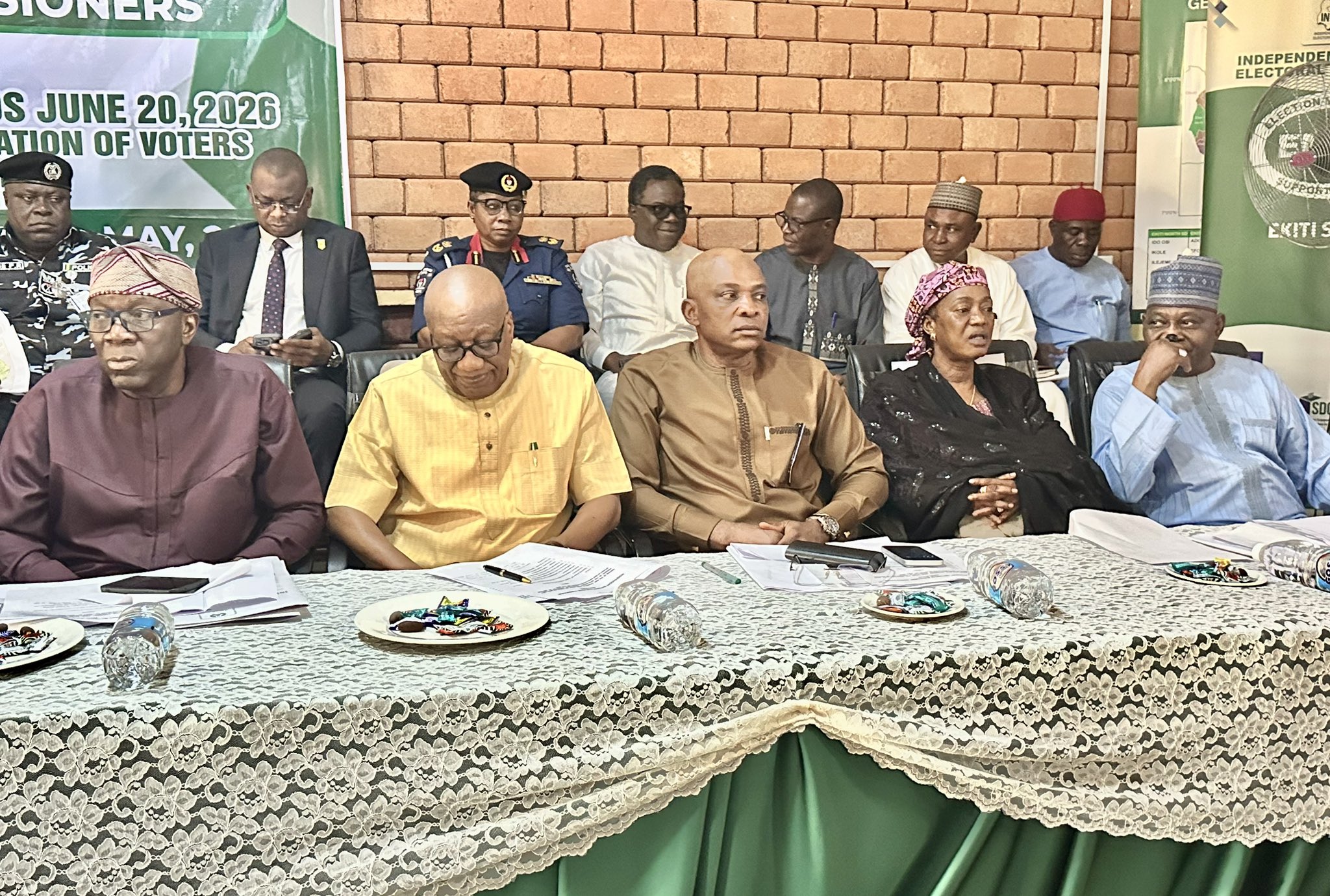
The disclosure came during stakeholder engagements ahead of the election, where INEC Chairman, Prof. Joash Ojo Amupitan (SAN), said the Commission had already advanced key operational preparations, including configuration of the Bimodal Voter Accreditation System (BVAS) and recruitment of ad-hoc personnel through the INECPRES portal.
Amupitan said the Commission was also moving to ensure eligible voters are not shut out of the electoral process, revealing that Permanent Voter Cards obtained through the Continuous Voter Registration exercise would soon be distributed across all 177 wards in the state.
According to him, “Permanent Voter Cards (PVCs) from the Continuous Voter Registration exercise would soon be distributed across the state’s 177 wards to ensure that eligible voters are not disenfranchised.”However, beyond logistics and voter preparation, security concerns appeared to dominate discussions.
The INEC Chairman disclosed that assessments carried out across Ekiti identified multiple flashpoints susceptible to electoral violence and criminal activity. These, he said, include areas vulnerable to political thuggery, cult-related activities, kidnapping, ballot box snatching and vandalism.
According to him, “469 polling units located within 500 metres of identified risk zones had been mapped out for special security attention.”
The revelation raises fresh questions about the scale of threats surrounding elections and the continuing challenge of securing polling environments across Nigeria.
INEC also issued a stern warning on vote buying — a recurring issue in recent off-cycle elections. Amupitan said the Commission was strengthening collaboration with anti-corruption agencies including the Economic and Financial Crimes Commission (EFCC) and the Independent Corrupt Practices Commission (ICPC) to apprehend and prosecute those involved in electoral inducement.
The intervention suggests growing institutional concern that security deployment alone may not address deeper integrity issues associated with Nigerian elections.
Also speaking, National Commissioner in charge of Planning, Monitoring and Strategy Committee (PMSC), Dr. Ken Ukeagu, said electoral risk management assessments conducted in April had produced valuable intelligence regarding potential threats ahead of the poll.
According to Ukeagu, “Electoral risk management assessments carried out in April provided critical insights into potential threats and security needs ahead of the election.”
He advocated stronger security presence in border communities and deeper cooperation among members of the Inter-Agency Consultative Committee on Election Security (ICCES) at the local government level.
Ukeagu expressed optimism that sustained collaboration among stakeholders would guarantee a smooth electoral process.
His remarks reflect an increasingly common strategy in Nigeria’s election planning process — heavy reliance on inter-agency coordination and preventive security intelligence.
Still, the developments raise a difficult question: Is INEC really serious in its words?
Observers note that similar assurances have accompanied previous elections, with promises of strict enforcement against vote buying, violence and electoral offences. Yet implementation has often become the true test.
Questions remain over whether identified flashpoints will receive sufficient security personnel, whether arrests over vote buying will translate into convictions, and whether preventive intelligence will actually stop disruptions before they occur.
For many voters, the issue may no longer be whether risks are identified, but whether institutions can act decisively enough to prevent them.
The Ekiti election could therefore serve not only as a contest for political power, but also as another measure of public confidence in Nigeria’s electoral system.
With preparations gathering pace and scrutiny increasing, all eyes may now shift from promises to performance.
