
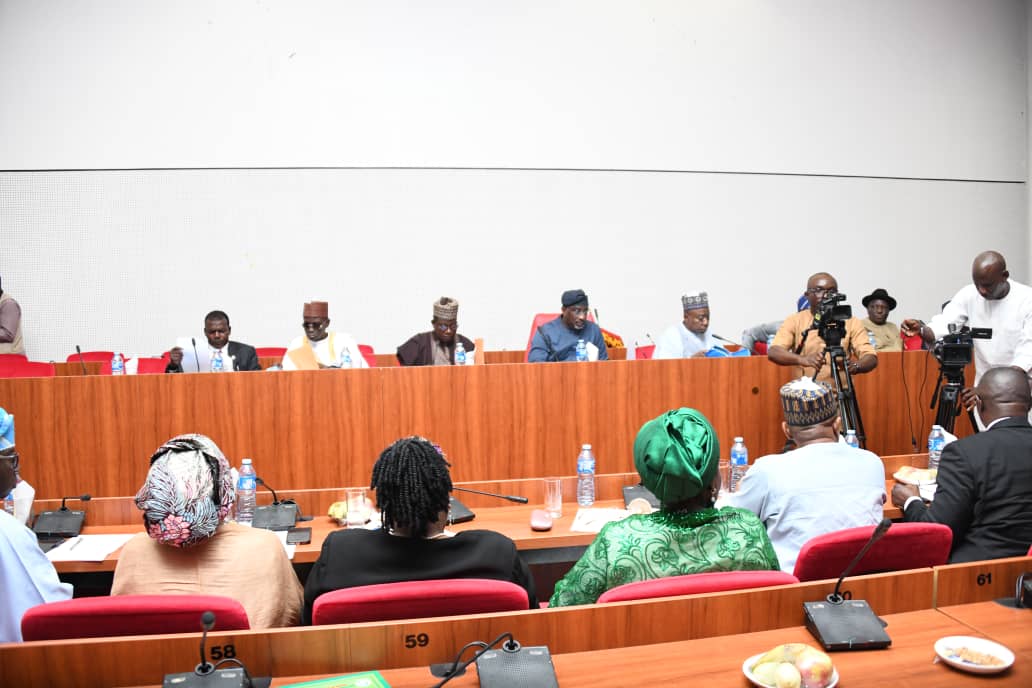
The Senate Committee on Judiciary, Human Rights and Legal Matters has screened and cleared 16 nominees for appointment to the governing board of the National Human Rights Commission (NHRC), including Eze Anaba, president of the Nigerian Guild of Editors (NGE).
The committee, chaired by Adeniyi Adegbonmire, completed the screening as part of the process to reconstitute the commission’s governing board following President Bola Tinubu’s request for Senate confirmation.
The committee’s report has been forwarded to the Senate for consideration, with the final decision on the nominations expected at plenary.
Anaba, who is also the editor of Vanguard Newspapers, said his nomination would provide an opportunity to deepen his longstanding engagement with human rights protection, which he described as inseparable from his journalism career.
Speaking after the screening, he expressed optimism that the nominees’ varied professional experiences would enhance the commission’s ability to protect the rights of Nigerians. He, however, cautioned against treating the committee’s clearance as final confirmation.
We’ve just been screened. We’ve just been confirmed. So don’t let us jump the gun. That’s number one,” he said.
Anaba said he was pleased with the committee’s decision but noted that the process remained incomplete pending the Senate’s consideration of the report.
“I’m happy to be approved at least by this screening committee. So until confirmation,” he said.
Reflecting on his career, the NGE president said human rights issues had remained a consistent part of his work as a journalist and would continue to inform his contribution if confirmed.
“I’ve done this human rights thing all my life. It has gone together with my journalism job. So it’s going to be a continuation of what I’ve been doing,” he said.
Anaba also disclosed that he had been involved in the activities of the NHRC before his nomination, although not at the level of its governing board.
He expressed confidence that the experience and expertise of the incoming members would strengthen the commission’s performance and improve its impact on human rights protection.
“I’ve been part of Nigeria’s Human Rights Commission for a while. Not at this level. But I can assure you that with the members we have in this council, Nigeria will benefit from a very good National Human Rights Commission,” he said.
Adegbonmire said the committee had concluded the screening exercise and would submit its recommendations to the Senate for a decision at plenary.
He explained that the outcome of the Senate’s deliberations would subsequently be communicated to the President through the Office of the Secretary to the Government of the Federation.
The decision of this committee will be conveyed to the Senate. And the Senate will take a position at plenary,” he said.
“And the Senate’s position will then be conveyed to the President through the Office of the Secretary General,” he added.
The committee chairman said the NHRC governing board was made up of 16 members, including representatives of the Federal Ministries of Justice, Interior and Foreign Affairs.
He explained that the representatives of the three ministries were not individually screened because the law identifies the offices to be represented rather than specifying particular individuals.
“The law says there should be 16 members. Three of the members are nominees of the Federal Ministry of Justice, Interior, and Foreign Affairs. But because they are not specific as to persons, we don’t screen them,” he said.
Anthony Ojukwu , the commission’s serving Executive Secretary, , a Senior Advocate of Nigeria (SAN), was also screened during the exercise.
During the proceedings, senators urged the nominees to uphold integrity, patriotism and a commitment to the national interest in carrying out their duties.
Peter Jiya, senator representing Niger South, said the nominees must prioritise the country’s interests over personal considerations as they prepare to take up responsibilities in a public institution.
He expressed confidence that the commission could make a meaningful difference in protecting human rights if its governing board approached its responsibilities with integrity and a strong sense of public service.
Jiya also commended the nominees’ professional and personal qualities, urging them to balance their individual convictions with the responsibilities attached to their proposed appointments.
He congratulated the nominees and expressed hope that they would make positive contributions to the commission’s work.
Tinubu had in April sought Senate confirmation for the reconstitution of the NHRC governing board in line with Section 2(3) of the National Human Rights Commission (Establishment) Act, 2010.
The provision requires Senate confirmation before the board can formally assume office.
The nominees represent different professional fields, including journalism, law, public administration, academia and the security services.
They include Anaba; Maupe Ogun-Yusuf of Channels Television; Ayo Adewuyi of the Nigerian Television Authority; Chinonye Obiaku, SAN; Roseline Tasha; Ambassador Adam Yubak Baku; retired Assistant Controller-General of Corrections Felix Lawrence; Edmund Chinonye; Oluwakemi Asiwaju Okere-Odo; Professor Adedeji Ogunji; Kingsley Chidozie; Mohammed Adelodu; Otunba Francis Meshioye; Patience Patrick; and Hawwa Ibrahim.
Salamatu Suleiman was nominated as chairperson-designate, while Ojukwu was retained as executive secretary.
The NHRC is mandated by law to promote and protect human rights, investigate alleged violations and encourage compliance with national and international human rights standards.
The reconstitution of the board comes amid continuing concerns over accountability, the protection of fundamental rights and the effectiveness of institutions responsible for safeguarding citizens’ freedoms.
Although the committee’s clearance advances the appointment process, the nominees must await the Senate’s decision at plenary before their confirmation can be concluded.
