
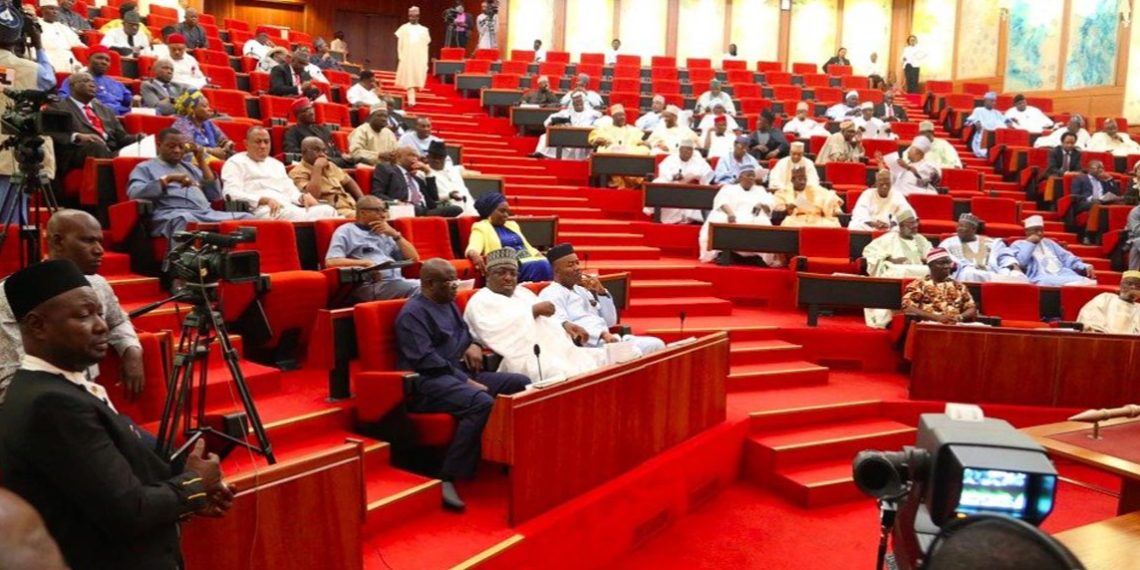
The Senate Committee on Interior has proposed safeguards to prevent qualified senior officers of the Federal Fire Service from being bypassed in the appointment of the Controller-General, a practice that could force them into premature retirement.
Chairman of the committee, Senator Adams Oshiomhole, made the position known on Tuesday, October 27, 2026, during the committee’s consideration of a proposed law to repeal the existing Fire Service Act and establish a new legal framework for the service.
Oshiomhole argued that the legislation should prioritise serving Deputy Controllers-General for appointment as Controller-General, except where objective circumstances make them ineligible.
He expressed concern that appointing a more junior officer to the position could force senior officers to leave the service before reaching the statutory retirement age or completing their years of service.
The senator said the law should promote fairness, merit and international best practices rather than preserve administrative practices simply because they had become established.
He noted that where several Deputy Controllers-General were serving in the Federal Fire Service, it was reasonable to expect that at least one would be qualified to succeed an outgoing Controller-General.
Oshiomhole proposed that the President should ordinarily appoint the Controller-General from among serving Deputy Controllers-General, except where objective considerations, including age, years of service or other eligibility requirements, made them unsuitable.
According to him, the legislation should establish clear conditions for departing from this principle rather than leave the appointing authority with unrestricted discretion to select a more junior officer.
The committee chairman also questioned a provision allowing the President to appoint the Controller-General from among serving officers not below the rank of Assistant Controller-General, arguing that it could undermine seniority and create uncertainty about career progression.
He maintained that public service laws should protect the legitimate expectations of officers who had risen through the ranks and prevent avoidable retirements arising from appointments outside the established hierarchy.
Oshiomhole acknowledged that similar practices existed in other security institutions, including the police and the military, but said their existence did not necessarily make them appropriate for inclusion in new legislation.
He urged lawmakers to use the proposed law to address administrative practices that could disadvantage qualified officers and weaken confidence in the promotion system.
During the meeting, another senator, a retired military officer, asked whether the Federal Fire Service operated an age-or-rank rule similar to the military, under which officers may be required to leave the service when a junior officer is promoted above them.
In response, the committee was told that the service had a rule requiring an officer appointed as Controller-General to have at least 18 months remaining before retirement. An officer who did not meet the requirement could serve in an acting capacity but could not be appointed substantively.
The committee also examined provisions governing the disclosure of official information and the confidentiality obligations of fire service personnel.
Oshiomhole acknowledged that public
institutions had legitimate confidential information but cautioned against using confidentiality provisions to undermine citizens’ rights to access information and demand accountability.
The proposed legislation requires officers and personnel of the Federal Fire Service to keep information obtained in the course of their official duties confidential and prohibits its use for personal or unauthorised purposes.
However, the provision recognises exceptions where disclosure is required by a court of competent jurisdiction or permitted under the proposed law, while preserving rights of access to information under the Freedom of Information Act and other applicable laws.
Oshiomhole said the legislation must be consistent with the Constitution and existing laws, stressing the need to balance legitimate confidentiality requirements with transparency and accountability.
The committee chairman also questioned a proposed general penalty for non-compliance with provisions of the legislation where no specific punishment had been prescribed.
The provision stipulates a fine of N200,000, imprisonment for two months, or both, upon conviction.
The committee further discussed the repeal of the existing Fire Service Act and the need to ensure that the proposed legislation adequately addresses the legal status of actions taken under the previous law.
Controller-General of the Federal Fire Service, Olumode Samuel Adeyemi, MBA, MDRM, FCNA, ACTI, represented the service during the meeting, where its management expressed appreciation to the committee for its work.
Oshiomhole said the committee would subject the proposed legislation to further scrutiny, including reviewing provisions that had not been adequately explained, to ensure that the final law was clear, fair and effective.
He emphasised that lawmakers should not rush the process, noting that careful examination of the provisions was necessary to produce legislation that would serve the interests of the service, its personnel and
