
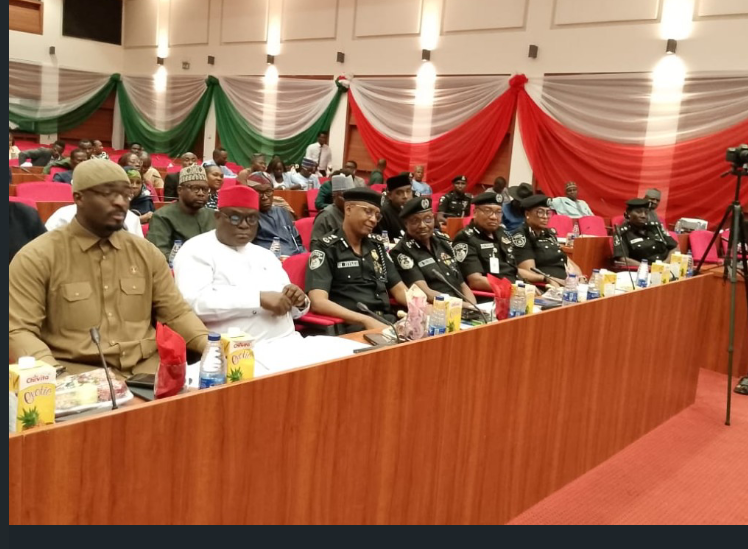
ABUJA — Nigeria’s Senate has intensified efforts to strengthen the country’s policing architecture following the advancement of a bill seeking to repeal and re-enact the Nigeria Police Trust Fund (NPTF) Act, amid growing concerns over funding constraints, accountability issues and institutional governance.
The proposed Nigeria Police Trust Fund (Establishment) Act, 2026, was the focus of a public hearing organised by the Senate Committee on Police Affairs on Tuesday at the National Assembly in Abuja.
Presenting the position of the Fund, the newly appointed Executive Secretary of the NPTF, Femi Mohammed Sheidu, described the legislation as a critical response to emerging security realities and the operational challenges confronting the Nigeria Police Force.
According to Sheidu, experience gathered from implementing the 2019 Act revealed structural weaknesses and funding limitations that have hindered the Fund’s capacity to fully support modern policing requirements.
“The proposed Act will strengthen institutional support for modern policing, ensure sustainable funding, and enhance accountability mechanisms necessary for effective service delivery,” he said.
He noted that Nigeria continues to face complex security threats, including terrorism, banditry, kidnapping, cybercrime and organised criminal networks, making a stronger legal and financial framework imperative.
A major provision in the bill seeks to increase the statutory allocation to the Trust Fund from 0.5 per cent to 1 per cent of the Federation Account. The legislation also proposes the removal of the sunset clause contained in the existing law, effectively making the Fund a permanent intervention mechanism.
Sheidu argued that making the Trust Fund permanent would encourage long-term planning, attract development partnerships and support sustained investment in police infrastructure and capacity building.
The bill also proposes broader funding channels through international grants, private-sector contributions and philanthropic endowments, while introducing stronger governance structures, enhanced oversight and improved reporting mechanisms.
Highlighting achievements recorded under the current law, the NPTF boss cited nationwide police training programmes, construction of smart police stations, procurement of operational vehicles and marine assets, rehabilitation of police barracks and deployment of modern policing infrastructure.
“These achievements show what is possible with dedicated funding, but more needs to be done to meet the realities of modern policing,” he added.
The Fund’s future plans include the establishment of state-of-the-art police hospitals across the country’s geopolitical zones, expansion of digital policing systems, housing schemes for officers and improved welfare support for personnel and their families.
Stakeholders at the hearing largely endorsed the proposed legislation but identified several areas requiring amendment before final passage.
Among the recommendations was a call for the representative of the Inspector-General of Police on the board to be elevated to the position of Vice Chairman, reflecting the operational expertise of police leadership.
Contributors also argued that responsibility for police needs assessments should reside with the Inspector-General rather than the Minister of Police Affairs to ensure operational realities drive resource allocation.
Observations were further made over the exclusion of Civil society organisations representatives from the proposed board structure, noting that such representation existed under the 2019 Act and served as an important accountability mechanism.
Another issue that drew attention was a controversial drafting error which reportedly described the Executive Secretary as a person of “questionable character.” Stakeholders urged lawmakers to correct the provision before the bill proceeds further.
Participants further expressed concern over the absence of provisions addressing how the Trust Fund would operate if Nigeria eventually adopts state policing, urging lawmakers to make the legislation adaptable to future policing reforms.
Debate also centred on police welfare, with lawmakers insisting that any increase in funding must directly improve salaries, pensions, insurance coverage and working conditions for officers.
Several senators lamented the operational difficulties faced by personnel, including inadequate equipment, self-funded logistics and limited support for families of officers killed in the line of duty.
Lawmakers equally criticised the widespread deployment of police officers to politicians, VIPs and private individuals, warning that the practice continues to reduce manpower available for core policing and public safety duties.
The hearing also witnessed criticism over the absence of the Inspector-General of Police and the Minister of Police Affairs, with some lawmakers describing their non-attendance as a failure to demonstrate accountability before the legislature.
Chairman of the Senate Committee on Police Affairs, Senator Ahmed Abdulhamid Mallam-Madori, assured stakeholders that all submissions would be carefully reviewed before the bill is finalised.
The legislation, transmitted by President Bola Tinubu as an executive bill, aligns with the administration’s security reform agenda and broader efforts to strengthen national security institutions.
If enacted, the new law could significantly expand the financial base of the Police Trust Fund, accelerate police modernisation projects and improve officer welfare. However, analysts note that the effectiveness of the reforms will ultimately depend on transparency, oversight and the proper utilisation of additional funding.