

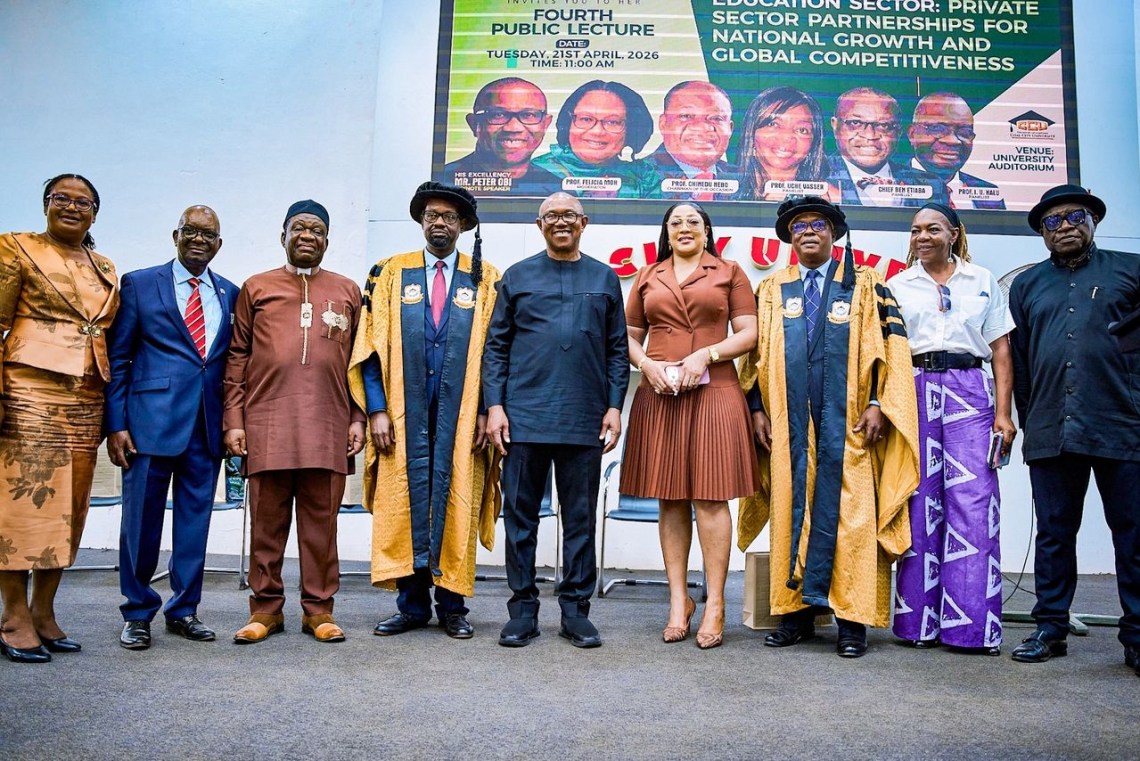
Former Labour Party presidential candidate, Peter Obi, has intensified his 2027 ambitions, holding a closed-door strategy meeting with South-east chairpersons of the African Democratic Congress (ADC) in Enugu.
Martins Ugwu, head of the ADC media team in Enugu, described the meeting as a “calculated show of regional alignment toward consolidating regional party structures,” noting it was Obi’s first engagement with the newly elected
South-east leadership of the party.
The talks, held with chairpersons across Enugu, Imo, Abia, Anambra, and Ebonyi, were aimed at strengthening cohesion, aligning leadership priorities, and deepening grassroots engagement as Obi positions himself for the ADC presidential primary.
Ugwu added that discussions centred on reinforcing internal party democracy and harmonising state-level operations, with Enugu chairman-elect Augustine Akubue among those in attendance.
The political moves come days after Obi revealed he held a breakfast meeting with foreign diplomats in Abuja on April 15, including the British High Commissioner and representatives from the European Union, Germany, Canada, and France.
“Today in Abuja, I had a breakfast meeting with some diplomats that included, the British High Commissioner to Nigeria and his colleagues from European Union, Germany, Canada, and France. It was an enriching discussion on relationships,” he wrote.
On April 21, Obi also took his message to Coal City University in Enugu, where he delivered a blunt assessment of Nigeria’s development challenges, linking them directly to poor investment in education.
“No nation rises above the quality of its education system,” he said.
“Nigeria’s current low Human Development Index (HDI) score of 0.548 and persistent high unemployment are clear symptoms of chronic underinvestment in education and human capital development.
“The data is equally revealing. Nigeria allocates less than 10% of its budget to education, far below the 15–20% global benchmark. Youth unemployment and underemployment exceed 30%, while life expectancy remains among the lowest 50–55 years. Literacy levels hover below average 59% and 65%, all of which point to deep structural weaknesses in our development trajectory.
“In contrast, comparable countries such as Indonesia and Egypt, and South Africa have high HDI levels with HDI scores of 0.72–0.75.
They all have higher life expectancy of above 65 years, higher literacy levels and higher per capita incomes of $3,500 above, while Nigeria is about $1000.
.This stronger progress was through sustained and deliberate investment in education, healthcare, and broader human capital development. The difference is not in talent, but in priority and policy consistency.”
He called for a sweeping overhaul of Nigeria’s education funding model, pushing for stronger public-private partnerships and inclusion of private institutions in intervention frameworks.
“We must move beyond rhetoric and confront these realities with urgency.
“It is difficult to justify excluding private universities from intervention frameworks like TETFund when they are actively contributing to national capacity building,” he said.
