

By CHARLES CHIJIOKE
The United States Department of State has announced plans to roll out a limited-edition United States passport design featuring the image and signature of President Donald Trump, a move that is already raising concerns about the politicisation of one of the world’s most important identity documents and its implications for America’s global image.
In a statement issued Tuesday, State Department spokesperson Tommy Pigott said the redesigned passport would commemorate the country’s 250th independence anniversary from the British monarchy, with distribution scheduled for July under the America250 initiative.
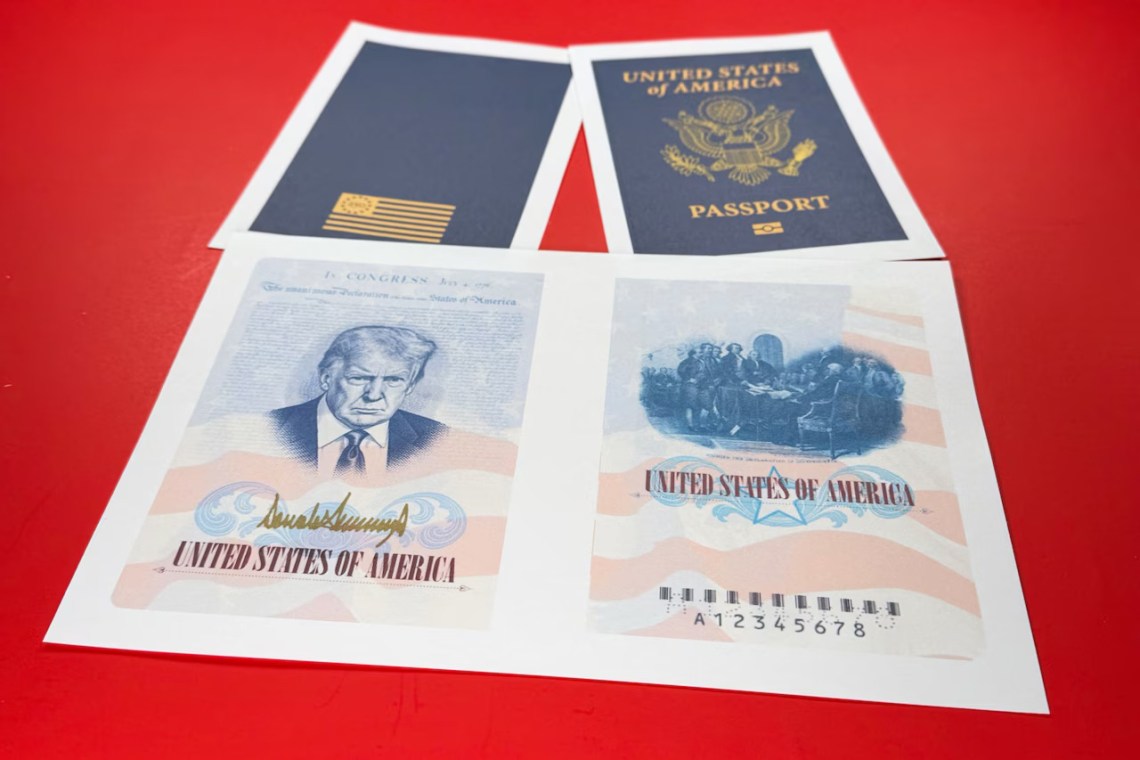
A mockup shared by the White House shows a blue-and-white image of Mr Trump’s face superimposed over the text of the Declaration of Independence, alongside the US flag and his signature in gold. Another page features the famous painting of the founding fathers signing the Declaration.
“As the United States celebrates America’s 250th anniversary in July, the State Department is preparing to release a limited number of specially designed US passports to commemorate this historic occasion,” Pigott said.
While officials describe it as commemorative, the State Department indicated the new booklet will become the default issued by the passport agency in Washington, with existing versions still available elsewhere — a detail that has intensified scrutiny over whether a temporary celebration is evolving into a lasting shift in how American identity is represented.
The decision carries weight far beyond US borders. The American passport is one of the most widely recognised travel documents globally, and any alteration to its symbolism is likely to be interpreted as a reflection of the country’s political direction. Analysts say embedding the image of a sitting president into such a document could blur the line between state and administration, potentially reshaping how allies and rivals perceive American institutions.
At home, the move may deepen political divisions, with critics arguing it undermines long-standing traditions that separate national symbols from individual leaders, while supporters see it as a bold expression of patriotism tied to a historic milestone.
The initiative is part of a broader effort by the administration to project national pride through visible symbols. A banner of Mr Trump’s face already hangs at the Department of Justice headquarters, while a 24-carat commemorative coin bearing his image has been approved. The Treasury Department is also reportedly moving to add his signature to US dollar bills.
Reacting to the development, White House spokesperson Olivia Wales said the “patriotic passport design provides yet another great way Americans can join in the spectacular celebrations for America’s 250th birthday,” adding that Mr Trump continues to “proudly lead a renewal of national pride and patriotism during our historic semiquincentennial celebration.”
However, beyond symbolism, there are practical and diplomatic implications. Foreign border officials, international institutions, and governments may be forced to interpret a more personalised American passport, potentially complicating perceptions of neutrality tied to official travel documents. There are also concerns that future administrations could reverse or redesign such changes, creating inconsistency in one of the most critical documents for global mobility.
As the US prepares for its semiquincentennial celebrations, the passport redesign underscores a broader question confronting the country: whether national identity should remain anchored in enduring institutions and founding ideals, or increasingly reflect the imprint of current political leadership, a debate now unfolding not just within America, but across the world.
