

By CHARLES CHIJIOKE
Former vice-presidential candidate of the Labour Party in the 2023 general election, Yusuf Datti Baba-Ahmed, has announced his decision to defect from the Labour Party to the Peoples Redemption Party (PRP), citing deepening internal disagreements and a shift from the party’s founding ideals.
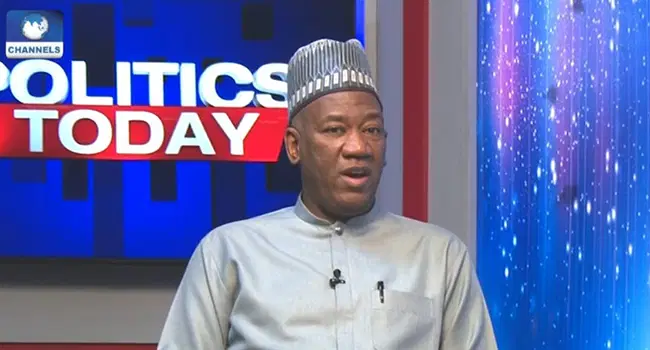
Baba-Ahmed made the disclosure on Tuesday during an appearance on Channels Television’s Politics Today, stating that his exit would take effect at midnight.
“I am leaving the Labour Party tomorrow. There is more to it. When there was real peace in the Labour Party, was when they posted back. They redeployed someone with a specific purpose, and because of the antecedent of the individual to make life difficult, particularly for me. What the Labour Party stood for then is no longer what it is today,” he said.
Confirming his next political move, the former running mate to Peter Obi declared: “I am leaving the Labour Party [at] midnight, and I am joining PRP. PRP is the new destination. PRP is the one with a history. It’s about 75 years old.”
The development marks a significant political shift within Nigeria’s opposition space, especially given Baba-Ahmed’s prominence during the 2023 elections where he ran alongside Peter Obi under the Labour Party banner. Their campaign drew widespread youth support and challenged the dominance of established parties, despite ultimately losing the presidential race.
The Peoples Redemption Party, founded in 1978 by the late Aminu Kano, has historically positioned itself as a progressive platform advocating social justice and pro-people policies. Baba-Ahmed’s defection is expected to revive attention around the party and potentially reshape alliances ahead of future electoral contests.
However, the announcement has sparked controversy across Nigeria’s political space, triggering sharp and divided reactions. Supporters of the Labour Party have criticised the move, with some describing it as ill-timed and capable of worsening the party’s internal crisis. Others accused Baba-Ahmed of abandoning a movement that drew strength from millions of young Nigerians seeking political change.
On social media, several commentators questioned the rationale behind joining the Peoples Redemption Party, arguing that the party currently lacks the nationwide structure and momentum built by the Labour Party during the 2023 elections.
Conversely, some Nigerians and political analysts have defended the defection, insisting that the internal wrangling within the Labour Party left him with limited options.
They argue that his move could breathe new life into the Peoples Redemption Party and revive ideological politics rooted in its historical legacy.
Analysts also warn that the controversy underscores a deeper challenge within Nigeria’s opposition landscape, as recurring internal disputes and high-profile defections risk fragmenting opposition strength ahead of future elections.
As reactions continue to trail the development, attention is now focused on whether other prominent figures within the Labour Party will follow suit or remain to stabilise the party, and how the Peoples Redemption Party will capitalise on the momentum generated by Baba-Ahmed’s entry.
