
BY. CHIJIOKE. CHARLES
The African Democratic Congress (ADC) has moved to strengthen preparations for its presidential primaries by appointing former Cross River State governor, Liyel Imoke, and former Kwara State governor, Abdulfatah Ahmed, to head key committees overseeing the process.
In a move seen as part of efforts to build confidence in its internal electoral process ahead of the 2027 political season, the party announced that Imoke will serve as Chairman of the Presidential Screening Committee, while Ahmed will lead the Presidential Election Committee.
The development was contained in a statement signed by ADC National Publicity Secretary, Bolaji Abdullahi, who said the party had carefully selected experienced figures to guide the process.
According to the statement, the Presidential Screening Committee will include Hon. C.I.D. Maduabum as Secretary alongside Alhaji Lawal Batagarawa, Prof. Bode Ayorinde, Hon. Nnena Elendu-Ukeje, Prof. David Salifu and Col. Abubakar Ali Ciroma.
The Presidential Election Committee, chaired by Ahmed, has Prof. Yisa Gana serving as Secretary, with Maj.-Gen. Adamu Jalingo, Dr. Auwalu Anwar, Chief Emenike Ikechi, Dr. Macaulay Iyare, Tajudeen Bakare, Elder Ubolo Itodo Okpanachi, Zainab Buba Galadima, Uzoamaka Onyeama and Maj.-Gen. Muhammad Inuwa Idris listed as members.
The party also constituted a Presidential Appeals Committee headed by Dr. Suleiman Usman, SAN, with Barr. Ken Imasuagbon serving as Secretary and Barr. Dare Okerade as member.
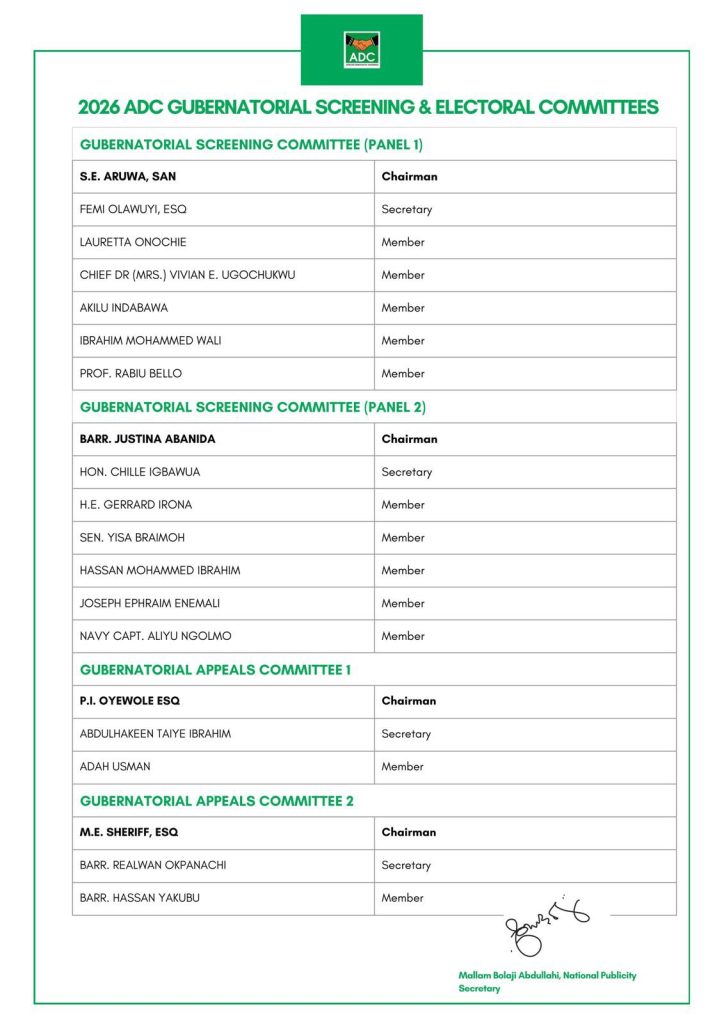
Beyond the presidential race, the ADC announced the formation of screening and appeals committees for governorship primaries across the country, an indication that the party is widening preparations for a broader electoral contest.
For governorship screening, the first panel will be led by S.E. Aruwa, SAN, while Barr. Justina Abanida will chair the second panel. The party equally constituted two governorship appeal committees to handle disputes arising from the exercise.
Explaining the rationale behind the appointments, the party stated that the committees were “carefully constituted to ensure transparency, credibility, fairness, and internal democracy throughout the conduct of the party’s primaries.”
The latest appointments come at a time Nigeria’s political space is gradually witnessing early alignments and strategic positioning ahead of the 2027 general elections. While major parties continue consultations and coalition talks, smaller parties such as ADC appear eager to project institutional readiness and internal stability.
Political observers say the selection of former governors and senior political figures to oversee critical party processes may be aimed at boosting confidence among aspirants and reducing allegations of bias, manipulation or procedural irregularities.
The decision could also signal ADC’s intention to present itself as a serious alternative platform capable of attracting influential politicians and emerging political movements seeking options beyond the dominant parties.
With the political calendar still unfolding, the effectiveness and perceived neutrality of these committees may shape both the credibility of ADC’s primaries and the party’s standing ahead of what is expected to be an intense 2027 electoral cycle.
