
By Charles Chijioke
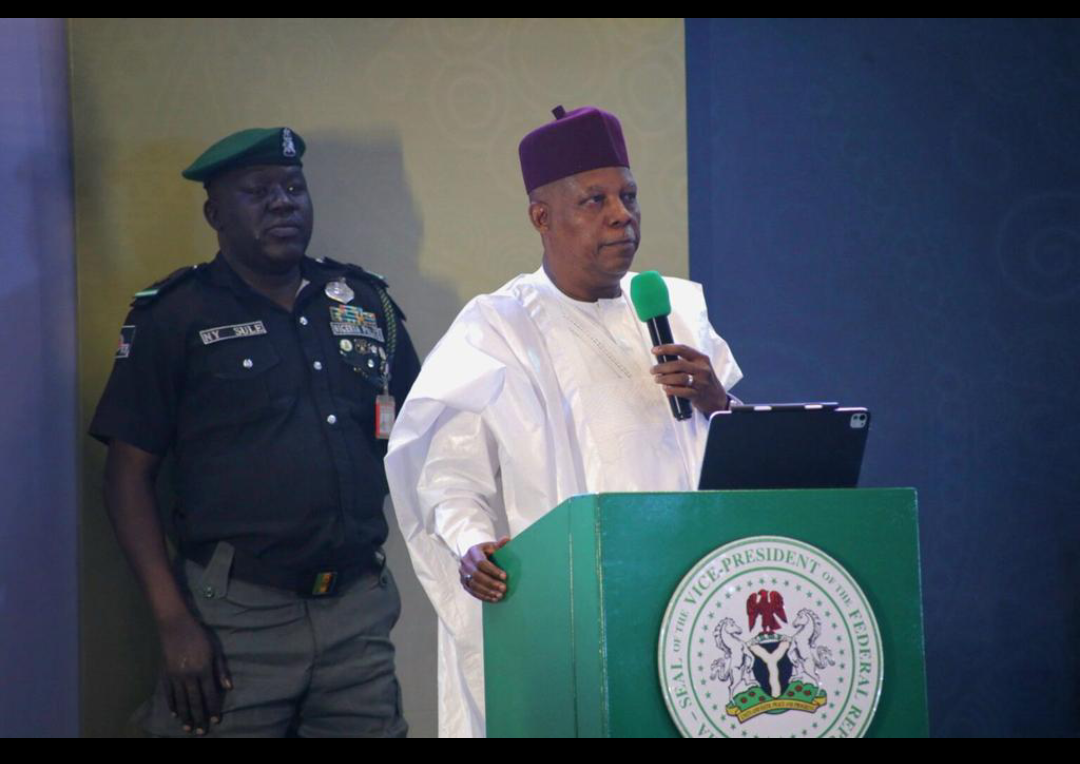
Vice-President Kashim Shettima has revealed how unnamed individuals allegedly attempted to sow distrust between him and President Bola Ahmed Tinubu shortly after they assumed office, claiming he had planned to assassinate the president and take over power.
Shettima made the startling disclosure on Tuesday in Abuja during the public presentation of the autobiography of former Head of State Yakubu Gowon. According to him, the incident occurred barely three months after the inauguration of the administration following the 2023 elections.
Narrating the episode, the vice-president said suspicion and political intrigues surfaced around traditional garments he had given Tinubu during the campaign period. He explained that during the presidential primary campaign, he purchased northern-style materials and caps to help Tinubu connect more with voters across the region.
“When we were campaigning for him to emerge as the candidate of the APC, we were going round the north. So, I got some materials and caps for him to blend with the northern crowd. It fitted him very well. So his aides said, ‘produce more, it fitted him,’” Shettima said.
He said matters later took an unexpected turn.
“Barely three months when we were sworn into office, some of my people from Borno came to him and said, ‘stop wearing those Shettima clothings. He must have charmed them. And you’re going to die. And he will become the president.’”
The vice-president praised Tinubu for refusing to entertain the allegations, saying the president confronted him directly after his return from an official trip to China.
“And to the eternal credit of the president. When I came back from China, where I represented him, he said, ‘sit down. Your people came to me and said I should stop wearing those garments you gave me.’”
According to Shettima, Tinubu found the allegation illogical because the garments had been given long before the presidency was secured. “But he said their story did not add up because when you gave those garments, I was an aspirant.”
Shettima further revealed that Tinubu deliberately continued wearing the garments for a week to demonstrate his rejection of superstition and political manipulation.
“For one week to prove to them that he is not fetish, he wore those garments. These are some of the gimmicks that are taking place in power circles in Nigeria nowadays.”
The vice-president used the incident to contrast present-day political culture with what he described as a period of deeper trust during Gowon’s era. Recalling historical relationships, he cited how gifts regularly exchanged among political and traditional leaders were accepted without suspicion.
“Here was a Christian son of the north, a child of the north-central, a soldier accepted across lines that others try to harden into walls in Nigeria,” Shettima said of Gowon.
“His life proved that identity can be carried without hostility. History teaches us that the Nigerian project becomes stronger whenever citizens refuse to become weapons in the hands of sectarianism and division.”
Beyond the personal revelation, Shettima also praised Gowon’s contribution to regional cooperation, highlighting his role in the creation of the Economic Community of West African States.
“As one of the builders of regional cooperation in Africa, the formation of the Economic Community of West African States remains one of the great acts of political foresight on the continent,” he said.
The comments may spark fresh political discussions over internal power dynamics within the presidency and could reignite conversations around trust, influence and succession anxieties often associated with Nigeria’s political elite. Analysts may also view the revelation as a rare public acknowledgment of the intrigues and undercurrents that frequently shape relationships within the highest levels of government.
The development comes amid intensified political activities and behind-the-scenes alignments ahead of future electoral calculations, making Shettima’s remarks likely to attract reactions across party and opposition circles.
