
By Charles Chijioke
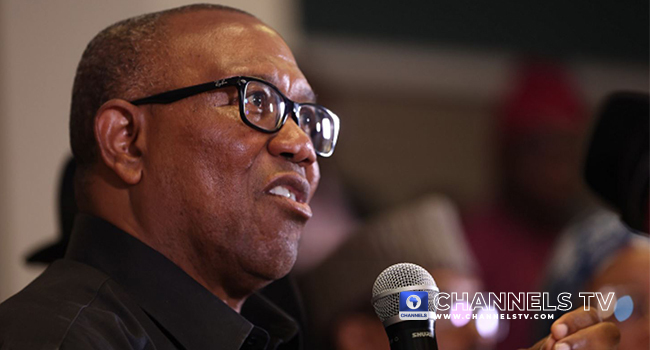
Afrilensnews reports that the 2027 presidential candidate of the Nigeria Democratic Congress (NDC), Peter Obi, has criticized President Bola Tinubu’s approval of the recruitment of 1,000 forest guards in Oyo State, describing the move as a reflection of “poor leadership” and a reactive approach to Nigeria’s worsening security crisis.
The criticism follows the Federal Government’s decision to authorize the recruitment after the recent abduction of schoolchildren, teachers, and other residents in Oriire Local Government Area of Oyo State, an incident that sparked nationwide outrage and renewed concerns over insecurity.
In a statement posted on his X account on Friday and titled “What Our Pervasive Insecurity Requires: A Holistic Not Reactive Approach,” Obi argued that while increasing security personnel is necessary, the manner in which the approval was granted raises serious questions about policy consistency and strategic planning.
“In a hasty effort to be perceived as attentive and courageous, it is reported that President Bola Tinubu has approved the recruitment of about 1000 forest guards for Oyo State,” Obi said.
“This is a further demonstration of poor leadership and attending to very serious governance and security issues with a reactive approach. It is the same reactive approach that led to the sudden removal of fuel subsidy and floating of the Naira that has caused irreparable damage to ordinary Nigerians and the economy.”
The former Anambra State governor maintained that security interventions should be carefully designed and implemented through a coordinated national strategy rather than through isolated responses to individual incidents.
According to him, insecurity is no longer limited to a few regions, noting that nearly all 36 states are experiencing various forms of violent crime, insurgency, banditry, kidnapping and communal unrest.
Obi specifically identified Oyo, Plateau, Kwara, Kogi, Borno, Katsina, Anambra, Niger, Imo and Sokoto states as among the most severely affected.
Questioning the broader implications of the approval, Obi asked whether every state facing similar threats would receive authorization to recruit an equivalent number of forest guards.
“The question, such as the reactive approach of our President, is whether all the states will receive the same approval to recruit 1000 forest guards per state, that is 37,000 forest guards for the 36 states and Abuja, or is the recruitment approval based on the mood of the President?” he queried.
Obi also raised concerns about the future of the South-West Security Network, popularly known as Amotekun, wondering whether the newly approved forest guards could create overlapping responsibilities with existing regional security structures.
“Moreover, with the approval for Oyo, what will happen to the Amotekun Corps that is trying its best to secure South-West Nigeria? Will they be disbanded in Oyo State?” he asked.
The opposition figure linked the country’s security challenges to what he described as leadership failures, arguing that the inability to effectively govern, create jobs and harness Nigeria’s economic potential has contributed significantly to rising insecurity.
“The pervasive insecurity we currently have is directly related to the failure of our ecosystem, particularly leadership. It is only failure in leadership that can lead to the death of over 10,000 innocent Nigerians since 2023, and Nigeria is ranked among the top-most terror-affected countries in the world,” Obi stated.
He further advocated what he called an “ecosystem approach” to national security, stressing that tackling insecurity requires economic reforms, job creation, national unity, industrialization and the effective utilization of resources across agriculture, mining, tourism, sports, water resources, oil and gas.
The remarks add a new political dimension to the debate surrounding the Federal Government’s response to the Oyo abduction, with supporters of the administration likely to defend the recruitment as an urgent intervention aimed at strengthening local security architecture and protecting vulnerable communities.
The development is expected to fuel further discussions on the effectiveness of Nigeria’s security strategy, the role of state-backed security outfits, and the balance between emergency responses and long-term reforms needed to address the country’s deepening security challenge
