
By CHARLES CHIJIOKE
Former Kano State Governor and ex-presidential candidate, Rabiu Musa Kwankwaso, has thrown his weight behind the decision of the Nigeria Democratic Congress (NDC) to zone its 2027 presidential ticket to the South, declaring that the move would promote fairness, unity and “true national healing” in the country.
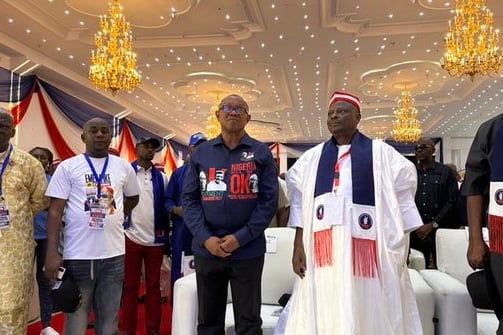
Kwankwaso made the declaration on Friday while addressing delegates and supporters at the National Convention of the NDC in Abuja, where he painted a grim picture of Nigeria’s current political and economic realities and accused the nation’s leadership of failing to prepare the country for changing global realities.
In a strongly worded speech delivered at the convention venue in the Federal Capital Territory, the former governor said Nigeria was currently at a “critical crossroads” due to bad governance, worsening insecurity and economic hardship.
“The world is undergoing a profound geopolitical shift, yet our nation has been caught unprepared, largely because of poor leadership,” Kwankwaso said.
“Instead of positioning Nigeria to seize emerging opportunities, bad governance has left us bearing the brunt of global changes.”
The former governor said ordinary Nigerians were facing declining living standards, rising insecurity and collapsing public institutions, warning that the situation had continued to weaken confidence in the country.
“We are witnessing a sharp decline in the quality of life. Insecurity has created widows and orphans across the land. Millions have been displaced from their homes. Investments are fleeing, critical infrastructure is neglected, the education system is collapsing, and harsh economic policies have been imposed on citizens without meaningful safety nets or relief,” he stated.
Kwankwaso also used the occasion to formally endorse the zoning arrangement adopted by the party leadership, insisting that allowing the South to complete its turn in producing the country’s leadership would strengthen national cohesion and restore confidence among different regions.
“It is therefore with great sense of unity and solidarity, that as a loyal party member, I support the decision to zone the presidential ticket of the NDC to the South, so that it allows the region to complete its turn in producing national leadership,” he declared.
“This represents a true opportunity for true national healing. We shall work in abidance with the party’s agreement to ensure fairness and federal character in all ramifications.”
In what appeared to be a veiled criticism of ethnic and religious politics in Nigeria, the former governor pledged that the NDC would promote inclusive leadership and national unity if voted into power.
“This party shall also ensure to change the way things are done today by prioritising leadership without ethnic jingoism and religious favouritism,” he said.
“The leadership standard we shall set will therefore restore Nigeria’s dignity and will guarantee that our citizens at home and the diaspora will be treated with respect and dignity.”
Kwankwaso further urged Nigerians, particularly young people and supporters of the emerging political movement, to register with the Independent National Electoral Commission (INEC) and participate actively in the democratic process ahead of the 2027 general elections.
The former governor referenced several historical political alliances in Nigeria, including the coalition between the Northern Elements Progressive Union (NEPU) and the National Council of Nigeria and the Cameroons (NCNC) in the 1950s, as well as the alliance between the NCNC and the Northern People’s Congress (NPC) before independence, arguing that national cooperation had always been critical to Nigeria’s survival and progress.
Political observers say Kwankwaso’s endorsement of a southern presidential ticket may reshape ongoing alignments within the opposition bloc ahead of the 2027 elections, especially amid growing debates over zoning, power rotation and coalition-building among emerging political parties.
The development is also expected to intensify conversations around regional balance, succession politics and the search for a formidable opposition capable of challenging the ruling establishment in the next electoral cycle.
